Ask Ricky
What It Does
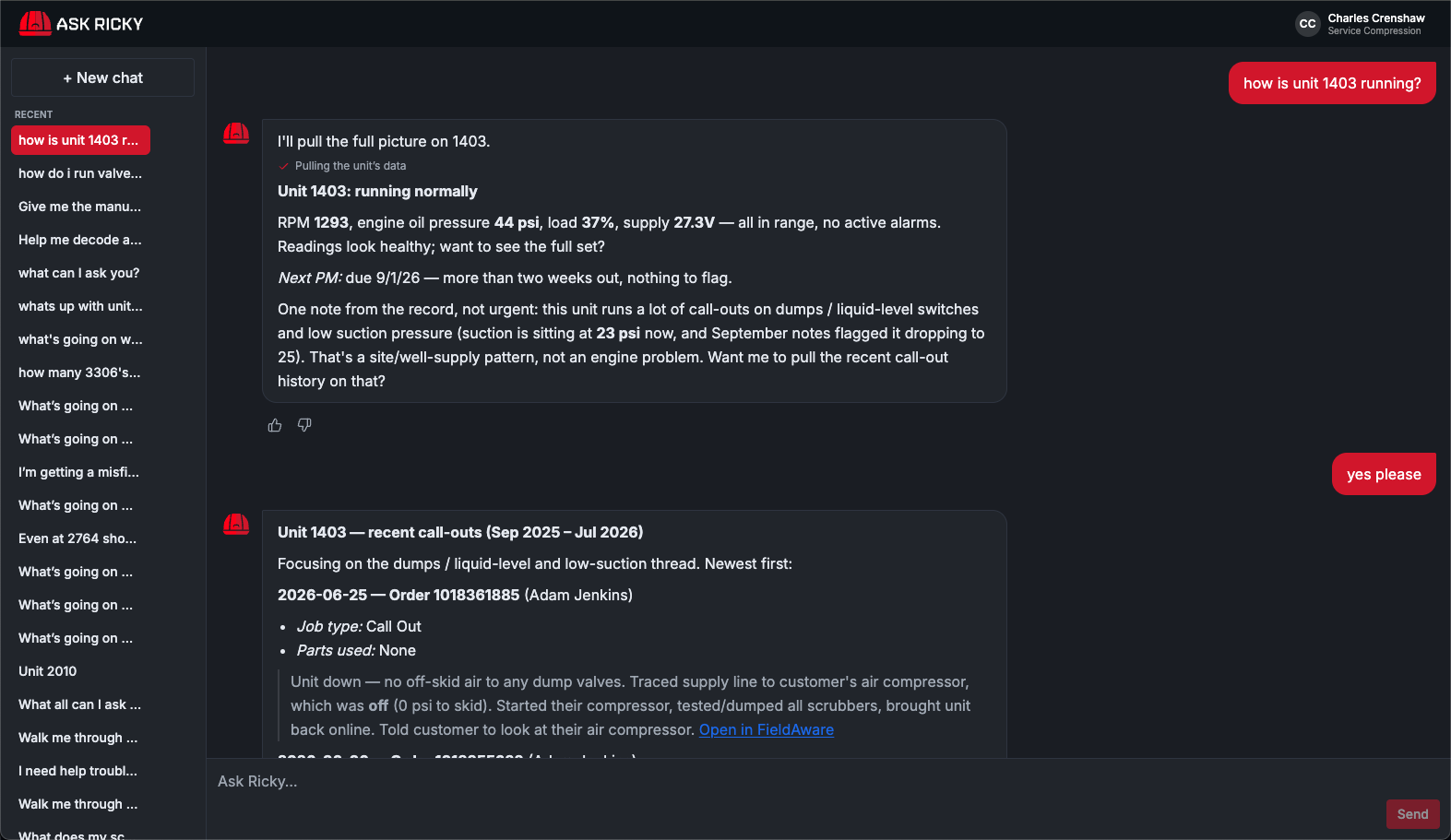
Ask Ricky is an AI chat interface — branded "Ask Ricky, powered by FieldTune" — that lets field mechanics ask equipment questions in plain language and get answers grounded in real data. Live telemetry from the compressor they're standing in front of, that unit's work order history, and a curated knowledge base built by subject matter experts.
Unlike a generic chatbot, Ask Ricky is scope-aware: it knows which unit the mechanic is asking about, pulls real-time data for that specific unit, and limits its answers to what the caller is authorized to see. It's a pure frontend SPA — all intelligence lives in the AI Engine, not the client.
Key Features
- Natural language questions about equipment — "Why is unit 4523 running hot?" or "Help me decode a fault code"
- Responses stream in real-time via Server-Sent Events (SSE) with a smooth 40ms rendering cadence
- Responses grounded in live sensor data from M-Link and Enbase
- Pulls work order history for the specific unit being discussed
- Searches a curated knowledge base of troubleshooting procedures and tribal knowledge
- Tool invocations shown as status chips during execution ("Searching knowledge base...") and persistent markers in the transcript
- Conversation sidebar — create, archive, and manage multiple threads
- Per-message feedback (thumbs up/down with reason categories) — feeds back into quality improvement
- Scope-aware authorization — callers only see data they're permitted to access
- Mobile-friendly for use in the field
How It Works
When a mechanic asks a question, Ask Ricky sends it (with their Entra bearer token) to the AI Engine orchestrator. The agent (Claude via Mastra) decides which tools to call based on the question and streams the response back in real time:
The AI Engine has access to these tools, gated by the caller's scopes:
| Tool | Required Scope | What It Provides |
|---|---|---|
| Search Knowledge Base | KnowledgeBase.Read | Curated troubleshooting guides + general knowledge (fault codes, torque specs). Component-scoped fuzzy matching (e.g., "Cummins KTA19") |
| Get Unit Profile | Assets.Read | Equipment makeup — engine, compressor, specs for the specific unit |
| Get Telemetry | Telemetry.Read | Live sensor readings from M-Link / Enbase — pressures, temps, RPM |
| Get Alarms | Telemetry.Read | Active alarm and fault codes for the unit |
| Get Work History | WorkHistory.Read | Past maintenance, repairs, and corrective actions |
| Get Corrective Maintenance | WorkHistory.Read | Outstanding corrective maintenance items |
| Diagnose Unit | Telemetry.Read | Structured diagnostic bundle combining multiple data points |
| Find Mechanics in Region | Directory.Read | Available mechanics for dispatch |
The Knowledge Base & Ricky Curator
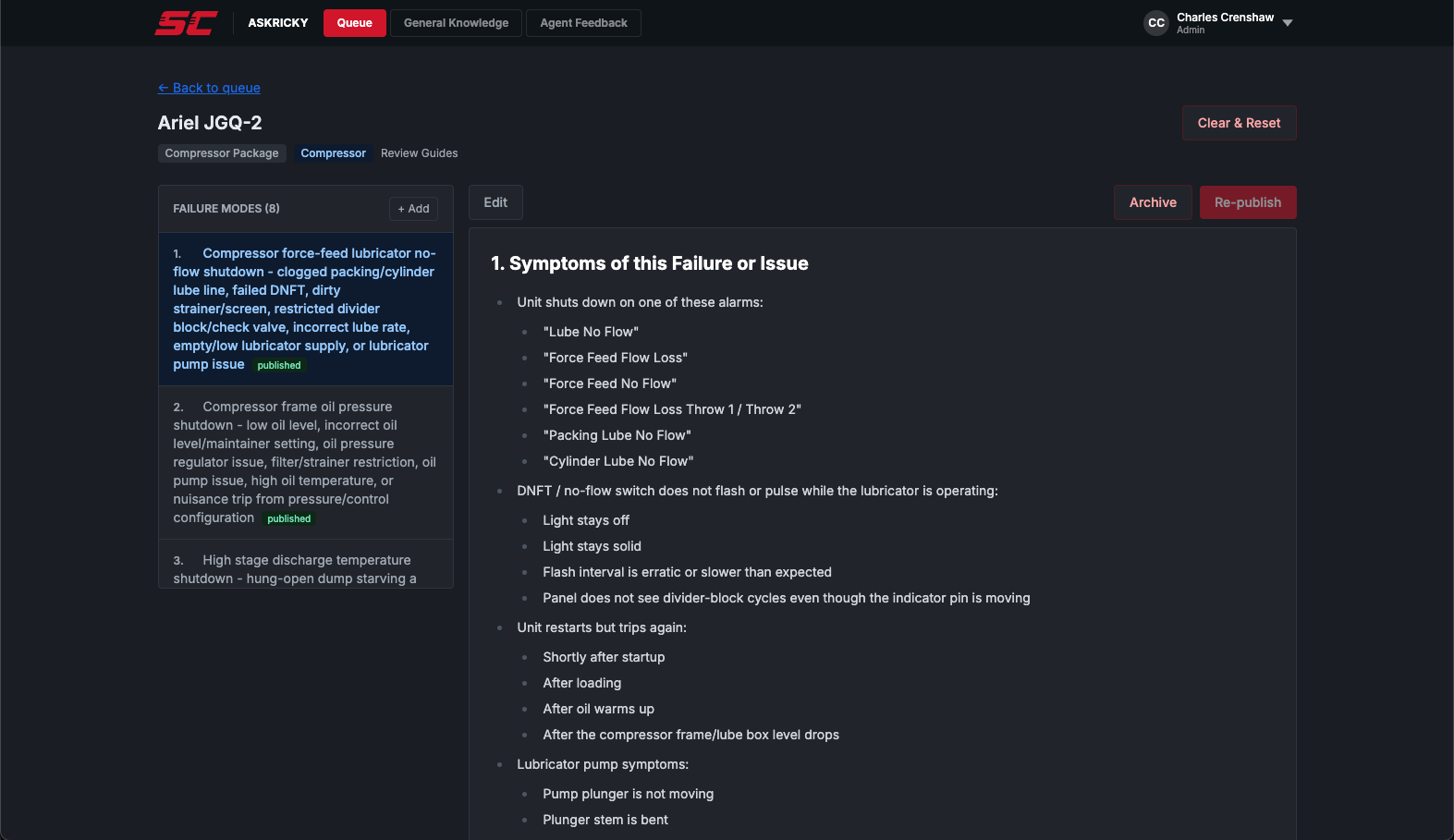
The knowledge base that Ask Ricky searches is not scraped from the internet — it's deliberately built and maintained by subject matter experts (SMEs) using a companion tool called Ricky Curator.
Knowledge Structure
Content is organized hierarchically: Tenant → Category (e.g., "Compressor Package") → Subject Kind (e.g., "Engine") → Subject (e.g., "Caterpillar 3306 TA") → Item (failure mode + troubleshooting guide).
The Curation Pipeline
- Stage 1 — Failure Mode Generation: SMEs (or AI debate engine) identify failure modes from reference documents uploaded for each equipment subject
- Stage 2 — Guide Expansion: Each failure mode is expanded into a detailed troubleshooting guide (AI-assisted or manual)
- Review: SMEs curate and approve the generated content before it goes live
- Publish: Approved guides are rendered to Markdown, stored in Azure Blob Storage, and automatically indexed by Azure AI Search
AI Debate Engine
Ricky Curator uses a unique approach: it orchestrates a "debate" between Anthropic Claude and OpenAI GPT to generate and refine content. SMEs configure strictness levels (strict grounding vs. open reasoning) to control how closely the AI sticks to uploaded reference material.
Search Strategy
When Ask Ricky's agent searches the knowledge base, it uses hybrid search (keyword BM25 + Azure semantic reranker). Results are scoped to the exact equipment subject being discussed, and a "General Knowledge" bucket (FAQs, fault code references) is always included alongside equipment-specific results.
Field Feedback Loop
Mechanics can flag answers as inaccurate. Feedback routes back into Ricky Curator's review panel via a webhook, where SMEs can triage, update the guide, and re-publish — closing the loop between field use and knowledge quality.
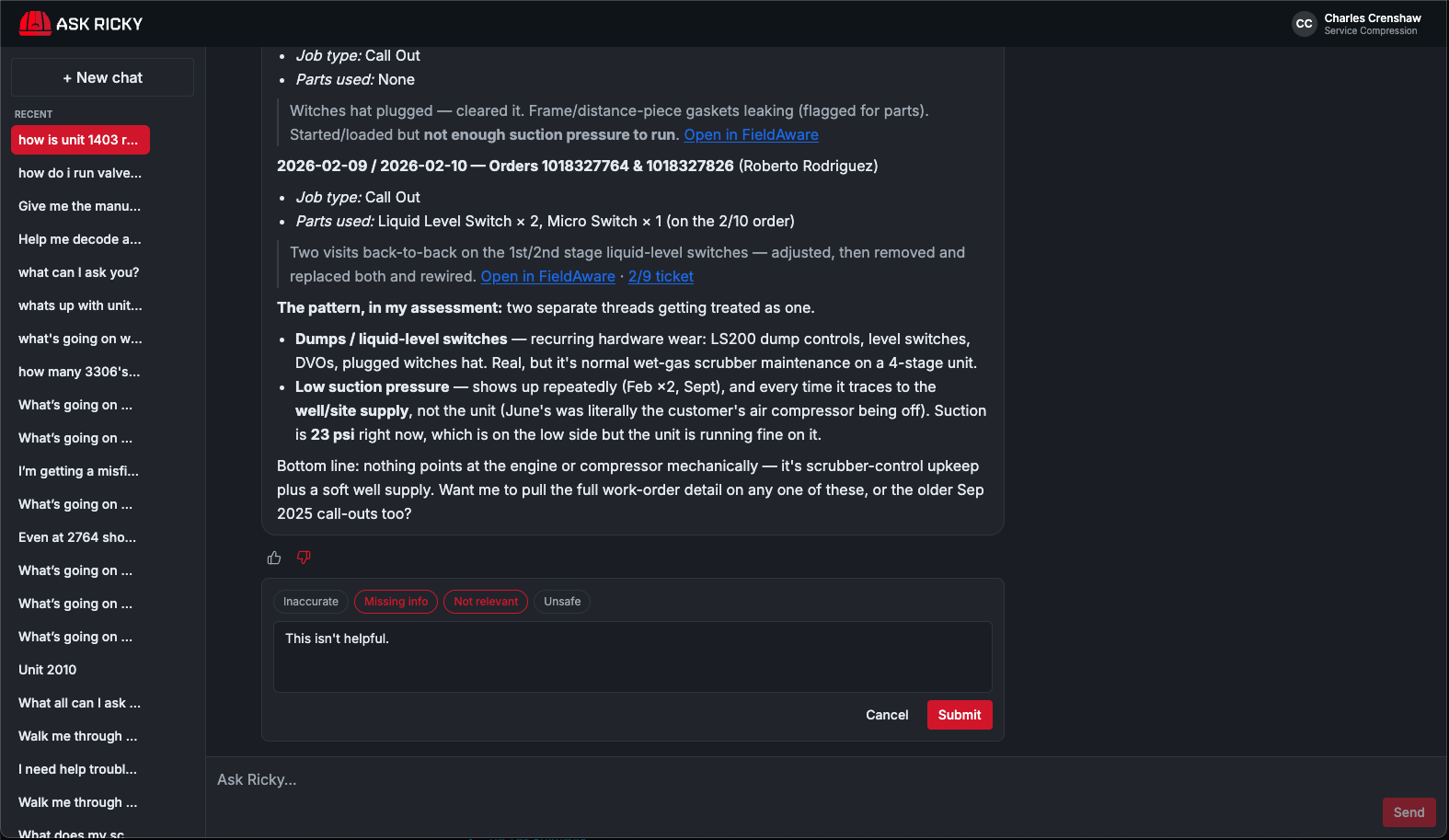
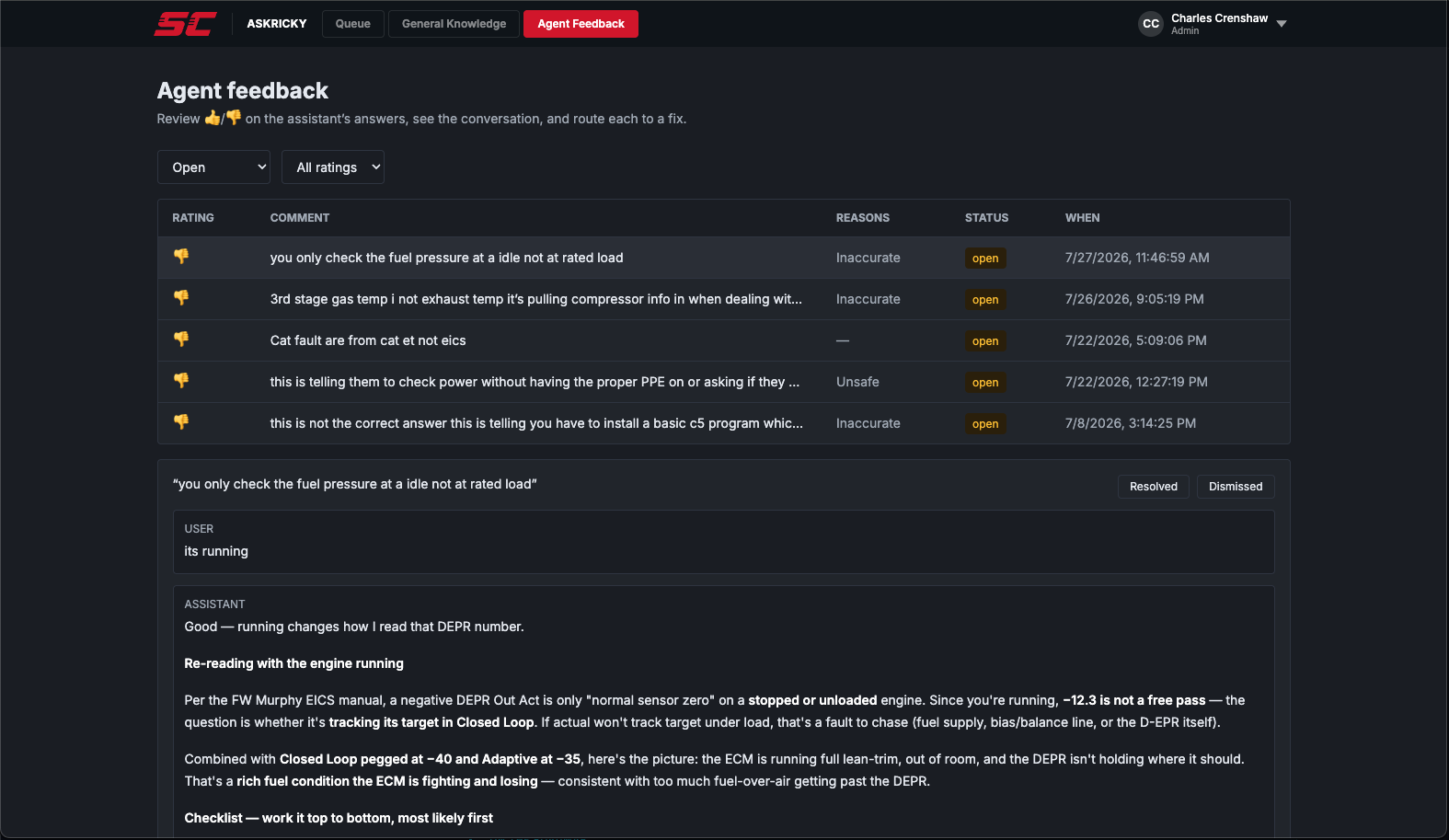
Most AI assistants pull from generic internet data. Ask Ricky's knowledge base is curated by the people who actually know this equipment — capturing institutional knowledge that would otherwise exist only in the heads of senior mechanics. The debate engine and feedback loop keep it improving over time.
Authorization & Scoping
Ask Ricky uses Entra ID (Microsoft Azure AD) for single sign-on, enforced through the platform's permissions and scoping model. When a mechanic opens the app:
- They sign in via Entra (PKCE-based, no API keys for humans)
- Their bearer token is sent with every request — the platform validates it and looks up their user record
- The
Agent.Runscope is required to chat at all; additional scopes gate which tools the agent can use - The AI agent dynamically composes its instructions and toolset based on the caller's scope profile
- Conversation threads are persisted server-side, scoped to tenant + user
- This same scoping model will power proactive agents — same security, different trigger
Administration
Ask Ricky's AI agent behavior, tool access, and integration configuration are managed through Platform Admin. The knowledge base content is managed through Ricky Curator. User scopes and group membership control what each mechanic can access.
The same AI engine and data connections that power Ask Ricky will power background proactive agents. No new integrations required — just a different trigger model (scheduled instead of user-initiated).